

 Peter Friedman
Universal Commerce Protocol: The Background and the Bigger Implication
Why This |Matters Now
Digital commerce is changing because customers are no longer always navigating websites themselves.
Increasingly, AI assistants are being asked to search, compare, recommend, purchase, track, and resolve issues on behalf of users.
That creates a practical challenge.
Most business systems were built for humans clicking through screens, not for AI agents completing structured tasks across multiple platforms.
What UCP Is Trying to Solve
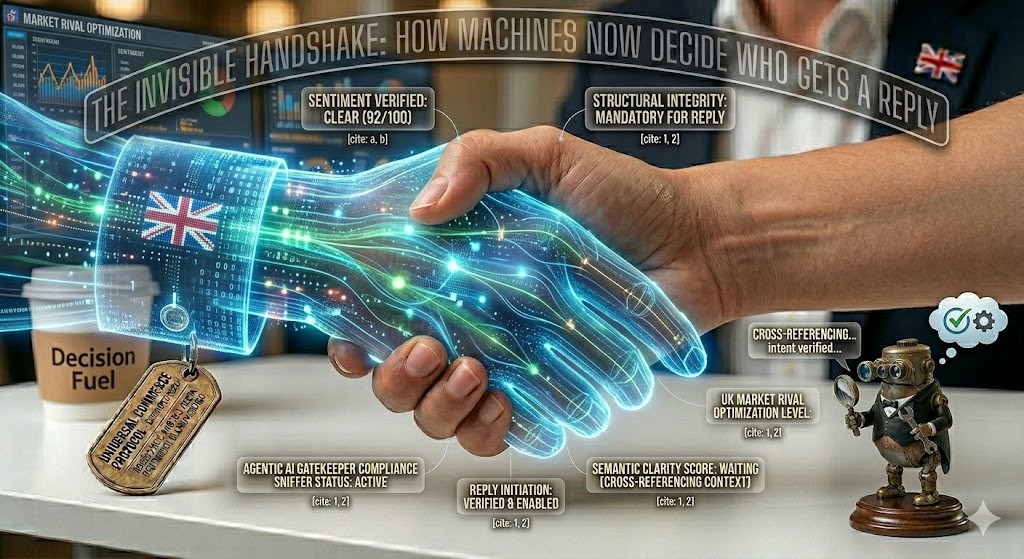
The Universal Commerce Protocol, or UCP, is part of the emerging response to that problem.
Its purpose is to create a more consistent way for AI agents, merchants, payment providers, and commerce platforms to exchange structured information.
In simple terms, UCP is about making commerce more machine-readable.
It is designed for situations where an AI assistant needs to understand products, prices, availability, checkout options, payment authorization, fulfilment, and post-purchase status.
Why Existing Commerce Systems Are Not Enough
Traditional ecommerce depends heavily on websites, apps, forms, baskets, and checkout pages.
That model works when people are browsing and making decisions manually.
It becomes less efficient when an AI agent is expected to complete the journey for the customer.
An AI agent does not simply need a webpage.
It needs reliable, structured access to the information and actions required to complete a transaction safely.
Who Is Behind It?
UCP has been led by Google as part of its work on agentic commerce.
It has also involved collaboration with major retailers, commerce platforms, payment providers, and technology partners.
The significance is not only technical.
When large platforms and commerce infrastructure providers support a common protocol, it can influence how businesses prepare their data, systems, and customer journeys.
What Spurred Its Development?
The main driver is the move from search-based commerce to agent-led commerce.
Instead of asking a search engine for options, a customer may ask an AI assistant to complete a task.
That task could include product discovery, comparison, purchase, delivery selection, returns, loyalty benefits, or customer support.
For that to work, AI systems need trusted ways to communicate with business systems.
UCP is one attempt to provide that shared structure.
What Is Its Current Status?
UCP should be treated as an emerging protocol, not as a universal requirement.
It is not yet the law of digital commerce.
It is also not an email standard.
Its importance lies in what it signals: commerce is moving toward structured interactions between software agents and business systems.
Who Is Likely to Implement It?
The first adopters are likely to be large retailers, ecommerce platforms, payment providers, marketplaces, and businesses with advanced digital infrastructure.
These organisations already depend on structured product data, APIs, customer records, payment flows, and automated fulfilment.
Over time, smaller businesses may face pressure to follow.
That pressure may come from platforms, customers, agencies, CRM vendors, payment providers, or marketing technology systems.
Why This Affects Customer Experience
Customer experience will increasingly depend on whether a business is understandable to machines.
That does not mean human service becomes irrelevant.
It means the first stage of the customer journey may be handled by automated systems before a person becomes involved.
If the business cannot provide clear data, the customer experience may break before the customer ever reaches a human being.
The Impact on CRM
CRM systems may become more important, not less.
They will need to hold cleaner, more structured, and more actionable customer data.
AI agents may rely on CRM-linked information to determine eligibility, preferences, service history, loyalty status, previous purchases, permissions, and next best actions.
Poor CRM data could therefore create poor automated customer journeys.
The Impact on CX Teams
CX teams will need to design journeys that work for people and software agents.
A journey may still need empathy, reassurance, and brand tone.
But it will also need clear rules, structured data, consistent handoffs, and reliable status updates.
The customer may judge the emotional experience.
The agent may judge whether the journey can actually be completed.
The Impact on Marketing
Marketing has traditionally focused on attracting human attention.
That will still matter.
However, agentic commerce adds another layer.
Brands may also need to make their offers understandable, comparable, verifiable, and actionable by AI systems.
Product data, pricing, claims, availability, reviews, fulfilment terms, and return policies may become part of machine-level visibility.
In that environment, messy marketing data becomes a commercial disadvantage.
The Impact on Email
UCP is not an email protocol.
However, it belongs to the same broader shift toward structured business communication.
Email is already filtered, classified, summarised, routed, and prioritised by automated systems.
That means business messages increasingly need to be clear to both people and machines.
Subject lines, sender identity, attachments, summaries, and calls to action all become more important.
The Impact on Business Communication
The larger trend is the move from informal communication to operational communication.
A message is no longer only a piece of writing.
It may also be a signal that enters a system, triggers a workflow, updates a record, or creates a task.
This changes what “good communication†means.
Good communication must be readable, actionable, verifiable, and easy to route.
The Risk for Organisations
The main risk is invisibility.
A business may still exist online, but become difficult for agents to understand or transact with.
If competitors provide cleaner data and smoother automated pathways, they may be easier for AI systems to recommend or use.
That could affect sales, service, retention, and reputation.
The Risk for Customers
Customers may experience this shift as convenience.
They may ask an assistant to handle more tasks and expect fast results.
But there are risks.
Automated journeys can fail when data is incomplete, permissions are unclear, or systems cannot explain decisions.
This creates new questions around transparency, consent, accountability, and escalation.
The Strategic Implication
UCP should be seen as an early marker of a wider transition.
Businesses are moving from digital presence to machine-operable presence.
It will not be enough to have a website, a CRM, a payment system, and a marketing stack.
Those systems will need to communicate clearly with authorised agents and platforms.
What Organisations Should Prepare For
Organisations should review the quality of their product data, customer data, payment flows, service rules, and consent processes.
They should also consider how their systems expose information to trusted platforms.
The goal is not to automate everything.
The goal is to make business interactions easier to understand, complete, audit, and improve.
The Longer-Term Outlook
The future of commerce may involve fewer manual journeys and more delegated journeys.
Customers may increasingly ask agents to act for them.
Businesses will then compete not only on brand and price, but on whether their systems can support those agents reliably.
That has implications for every function connected to the customer.
CX, CRM, marketing, ecommerce, service, compliance, and communications will all be affected.
The Core Point
UCP is not just about checkout.
It points to a broader shift in how business systems communicate.
The organisations that adapt will make themselves easier to discover, understand, trust, and transact with.
The organisations that do not may find that customers still want what they offer, but the systems around those customers cannot easily reach them.
Footnote Zone for Universal Commerce Protocol: The Background and the Bigger Implication
The inbound contactability audit proposed in this article can be made practical through four diagnostic tools developed by Nok Nok, a specialist in online responsiveness tool design, each addressing a specific weakness created by machine-mediated commerce and automated customer journeys.
- Email Finder: As organisations hide contact options, abandon monitored mailboxes, or push customers into restrictive web forms, Email Finder scans an organisation’s website for published addresses and reports structural deficiencies, missing routes, inconsistent contact signals, and discrepancies between stated accessibility and actual reachability.
- Reply Radar: As response times fall, human queues become understaffed, and automated routing systems determine which messages receive attention, Reply Radar deploys targeted test emails and quantitatively measures reply rates, response latency, escalation behaviour, and the operational gaps that prevent customers from receiving timely human or system-led responses.
- Compliance Sniffer: As automated service environments produce hallucination loops, empty platitudes, generic apologies, or degraded message quality, Compliance Sniffer analyses incoming responses against objective quality and compliance benchmarks, identifying whether replies are accurate, relevant, complete, accountable, and suitable for customer-facing use.
- Mystery Shopper: As customer journeys become shaped by systemic UX breakdowns, aggressive gateway filters, defensive forms, and machine-led routing, Mystery Shopper executes a comprehensive end-to-end responsiveness UX audit, testing whether a customer can make contact, progress a request, receive a meaningful reply, and complete the intended journey without avoidable friction.

Sources and relevant reading for Universal Commerce Protocol: The Background and the Bigger Implication
- Getting started with Universal Commerce Protocol on Google
Date: Accessed 4 June 2026
Relevance: This is the primary Google developer guide for UCP. It supports the article’s explanation that UCP is an open standard intended to enable agentic actions across AI Mode in Google Search and Gemini, beginning with direct buying. - Under the Hood: Universal Commerce Protocol (UCP)
Date: 11 January 2026
Relevance: This Google Developers Blog post is the most useful source for explaining who is behind UCP, why it was created, and how it is intended to work. It confirms that UCP was developed by Google with industry collaborators and is designed to reduce fragmented integrations between agents, businesses, and payment providers. - Universal Commerce Protocol
Date: Accessed 4 June 2026
Relevance: This is the public UCP project site. It supports the article’s description of UCP as a common language for platforms, agents, and businesses, with building blocks for discovery, checkout, and wider agentic commerce use cases. - New tech and tools for retailers to succeed in an agentic shopping era
Date: 11 January 2026
Relevance: This Google Ads and Commerce article places UCP in a wider retail and marketing context. It is useful for supporting points about merchant discovery, branded AI agents, direct buying, Google Pay, and the commercial shift from search-based shopping to agent-assisted shopping. - Agentic Commerce: AI Shopping Agents Guide 2025
Date: 2025
Relevance: This Deloitte article supports the article’s wider claims about agentic commerce reshaping retail strategy. It is particularly relevant to the sections on organisational readiness, agent-ready data infrastructure, APIs, interoperability, trust, governance, and the pressure on retailers to adapt. - How AI Agents Are Opening the Golden Era of Customer Experience
Date: 13 January 2025
Relevance: This BCG article supports the CX argument. It explains how AI agents are changing customer journeys, reducing cost-to-serve, and moving companies from isolated touchpoints toward broader customer “missions†managed by autonomous agents. - Agentic CRM systems: Learnings from organizations making the switch
Date: 4 June 2025
Relevance: This Microsoft Dynamics 365 article supports the CRM section. It is relevant to the article’s claim that CRM systems are becoming operational platforms for AI-assisted sales, service, marketing, workflow automation, and customer data consolidation. - Gartner Predicts Agentic AI Will Autonomously Resolve 80% of Common Customer Service Issues Without Human Intervention by 2029
Date: 5 March 2025
Relevance: This Gartner press release supports the article’s discussion of customer service automation. It is useful for the point that inbound interactions, routing, resolution, and escalation are increasingly being reshaped by agentic AI. - CRMAgent: A Multi-Agent LLM System for E-Commerce CRM Message Template Generation
Date: 11 July 2025
Relevance: This academic paper supports the marketing and CRM communication sections. It shows how multi-agent systems are already being applied to e-commerce CRM messaging, including customer segmentation, message generation, and performance-driven template improvement. - Email as the Interface to Generative AI Models: Seamless Administrative Automation
Date: 30 June 2025
Relevance: This academic paper supports the article’s point that email is becoming part of a broader automation environment. It is useful for explaining how email can act as an interface for AI-driven administrative workflows rather than only as human-to-human correspondence. - The agentic commerce opportunity: How AI agents are ushering in a new era for consumers and merchants
Date: October 2025
Relevance: This McKinsey report supports the article’s broader strategic framing. It is relevant to the claim that agentic commerce may change how consumers shop, how merchants compete, and how value flows between customers, platforms, brands, and payment systems.


